
Originally written in Summer 2020 for my Economic Geography course
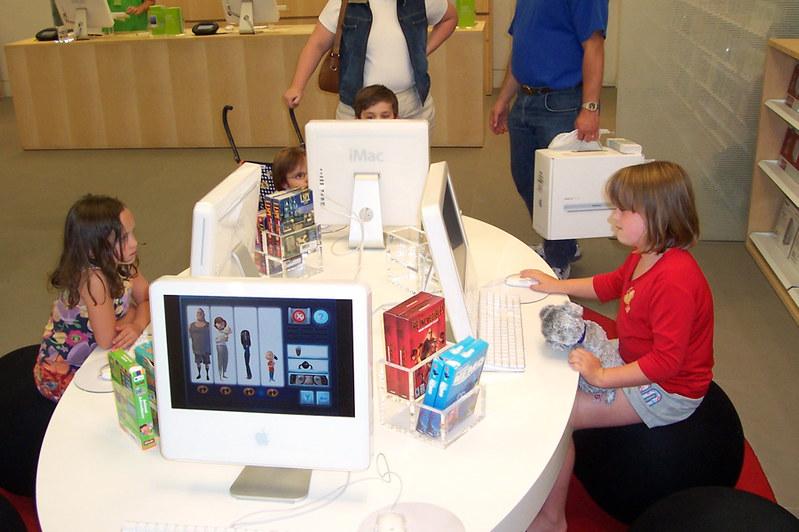
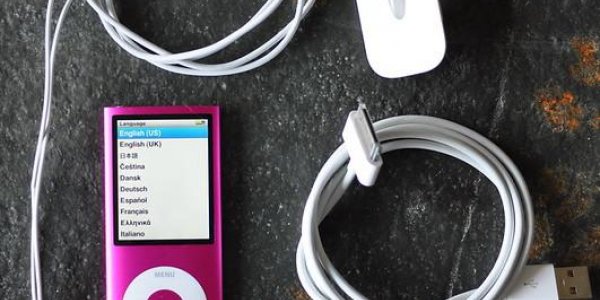
We live in a remarkable age of fast, digital communication. I was born only a few years before the smartphone was introduced, so I often reflect on how high-tech and low-tech communications affected my upbringing. For example, I spent most of my pre-teen years using an iPod for games and music, but I also grew up going to the VHS video store, or playing hard disk games on my dad’s 1990s Macintosh. Into my teen years, the world of digital communication accelerated very fast, and we accepted each update with open arms. Many of us don’t think twice about how much we understand social media, computers, networks, Wi-Fi, and cellular data compared to previous generations of children. It is less reflected on by us and more just experienced.
 Pre-teen me on my parent’s iPhone. Derek K. Miller.
In this article I aim to analyze and reflect on how distance affects digital communication. I argue that while distance is much less of a barrier to communication than it was before the internet, there is still a discernible local tendency to our texts and emails. My summer Economic Geography class took an online survey on our own communications data. It shows a presence of distance decay, and I support this with a study that makes similar conclusions from analyzing millions of tweets in the USA.
To explore how distance affects digital communication, our class provided personal data from our own online interactions. We took a survey indicating the location of two communication categories: emails and texts. By looking at the first few messages in each category which we have sent and received on two platforms of our choice, we indicated where they came from. These options included Local, Rest of British Columbia, Rest of Canada, and Elsewhere. Lastly, we indicated the purpose of each message: Social, Educational, Family, or Economic. After the data was compiled on our class platform for all 270 students, I put it into a spreadsheet for analysis. I split the data up based on the Email/Text categories, each were split by their respective Outgoing/Incoming categories, and then location categories. I was able to create bar graphs to represent each Outgoing/Incoming section for both texts and emails. I also performed an identical analysis on my personal submissions for the survey, which I will touch on later.


From top to bottom: Graphs 1A, 1B, 1C, 1D. Bar graphs displaying class data from 270 students’ emails and texts.
To summarize the four graphs above, most communications were local and social. Outside of MetroVancouver, emails were mostly economic, and texts were mostly with family. People were receiving economic emails, possibly from banks or credit card companies. Texts sent and received from out of town were mostly with family, which indicates when people are messaging people who do not live nearby, they are family, because they’re more likely to speak with close-by people in person. COVID-19 complicates this trend, though. The data our class submitted was in the midst of global self-isolation orders. During this pandemic we are likely much more inclined (and often forced) to talk to family in our area and out of town digitally, because it is not as safe to be face-to-face. In an economic and health sense, digital communication is considered critical (United Nations DESA, n.d.). Governments are being encouraged to take full advantage of digital platforms during the pandemic. The most notable trend of class data was that the overwhelming majority of messages were local. For our class even in pandemic, more distance means less communications. To provide necessary definition, distance decay is a geography concept which proposes that “spatial interaction decreases with increasing distance between two places because of the penalties in travel time and cost associated with longer distances. This effect has been termed the ‘friction of distance” (Han et al., 2018, p. 451). In the context of economics, the globalization of communication has streamlined trade and business in many ways. Of course, there are physical materials and products involved in economic activities that can’t travel over the internet, but the administration of their sales can be. Notably, “once the initial set-up costs are covered, electronics communication networks can accommodate vast numbers of potential transaction partners at little extra cost” (Hayter and Patchell, 2016, p. 407). Are individuals just as likely to talk to far-away people as they are close by ones? Looking at the class data, no.
To further support this distance decay in cyberspace, I draw from an empirical study of millions of tweets from four major American cities. The authors wanted to take theorizing about distance decay further, and actually test it with data. They note that “social media are revolutionary forms of communication and have unique characteristics that are differentiated from other conventional forms of communication such as televisions, radio, telephone calls, emails, and video chatting” (Han et al., p. 454). People rarely interact in person with people farther than 500km away, and they find that there is distance decay for digital communications up until about 1000km away from the sender. After 1000km, however, distance does not cause noticeable friction anymore. Overall, “there is a distance decay effect in cyberspace, but the effect is weak” (Han et al., p. 464). We are most likely to interact with people close by, as Tobler’s 1st law of geography always predicted (Han et al. p. 451). The authors re-define this law to include the existing decay in cyberspace interactions, though it is less intense.
When looking at my personal survey data, a similar decay trend is seen compared to the class. I rarely speak to people out-of-province, and even less so with people out of the country. When discussing the topic of this paper with my family, my mom pointed out that when our friend from Australia visits, they are best friends. But when she goes home, they naturally stop talking for the most part, even with social media to aid them. She also pointed out that with the current pandemic, they have been talking more online. Discussing how our different countries are experiencing the virus is interesting, so they find themselves messaging more. My data points are exclusively social or educational, and every single one is local.

My data for outgoing emails, which is similar to the rest of my submissions.
This connects back to the class’ data. I suspect that in our class we are talking with people more from out of town, and talking with people in town online because of self-isolation. We are more likely to chat with family around the world because we want to check in on their health or ask what it’s like to be in their country during COVID-19. Locally, I am talking to people more online who live in my own neighbourhood! When I can’t see my friends, social media and messaging apps are our saving grace. And I suspect this is the case for most of my classmates.
It was interesting to explore the class data and search for other sources to help make sense of distance decay. There are academics on both sides of the argument whether we are seeing the ‘death of geography’. Some think distance decay does not affect cyberspace in any significant way, and others think Tobler’s law persists into the modern age. Based on the class text, class data, and the empirical study by Han et al. (2018), I agree that distance decay still applies to online communication. We are more likely to communicate in person and online with people who live nearby than those who are farther away. This has implications for economic activity, as a lot of trade and sales occurs online. The majority of small businesses I shop from online are in the U.S. and Canada, and this is likely not a coincidence. It is clear that “geography has been effective in determining the grooves of economic life through its effect on transportation and communication” (Hayter and Patchell, p. 403). It is great being a student of Geography in this high-tech age, because I am equipped to reflect on how far my relationship with communication has come since I was born. Kids my age would sit on the counter and talk to their grandparents on the wired landline phone, and may text those same grandparents on their iPhone today! Even though we can talk to almost anyone in the world at almost any time, human nature seems to prefer keeping conversations close to home. Maybe it is our innate need for community, and one in close proximity. Everyone should be able to appreciate our society’s technological ability, but also cherish those face-to-face encounters which the pandemic has taken away.
Sources
“Digital Technologies Critical in Facing COVID-19 Pandemic \| UN DESA Department of Economic and Social Affairs.” United Nations retrieved from http://www.un.org/development/desa/en/news/policy/digital-technologies-critical-in-facing-covid-19-pandemic.html.
Han, Su Yeon, et al. “Revisiting the Death of Geography in the Era of Big Data: the Friction of Distance in Cyberspace and Real Space.” *International Journal of Digital Earth*, vol. 11, no. 5, 2017, pp.451–469., doi:10.1080/17538947.2017.1330366.
Hayter, R., & Patchell, J. (2016). *Economic geography: An institutional approach*. Don Mills, Ontario, Canada: Oxford University Press.
Photos from Derek K. Miller via Flickr
 marina miller