
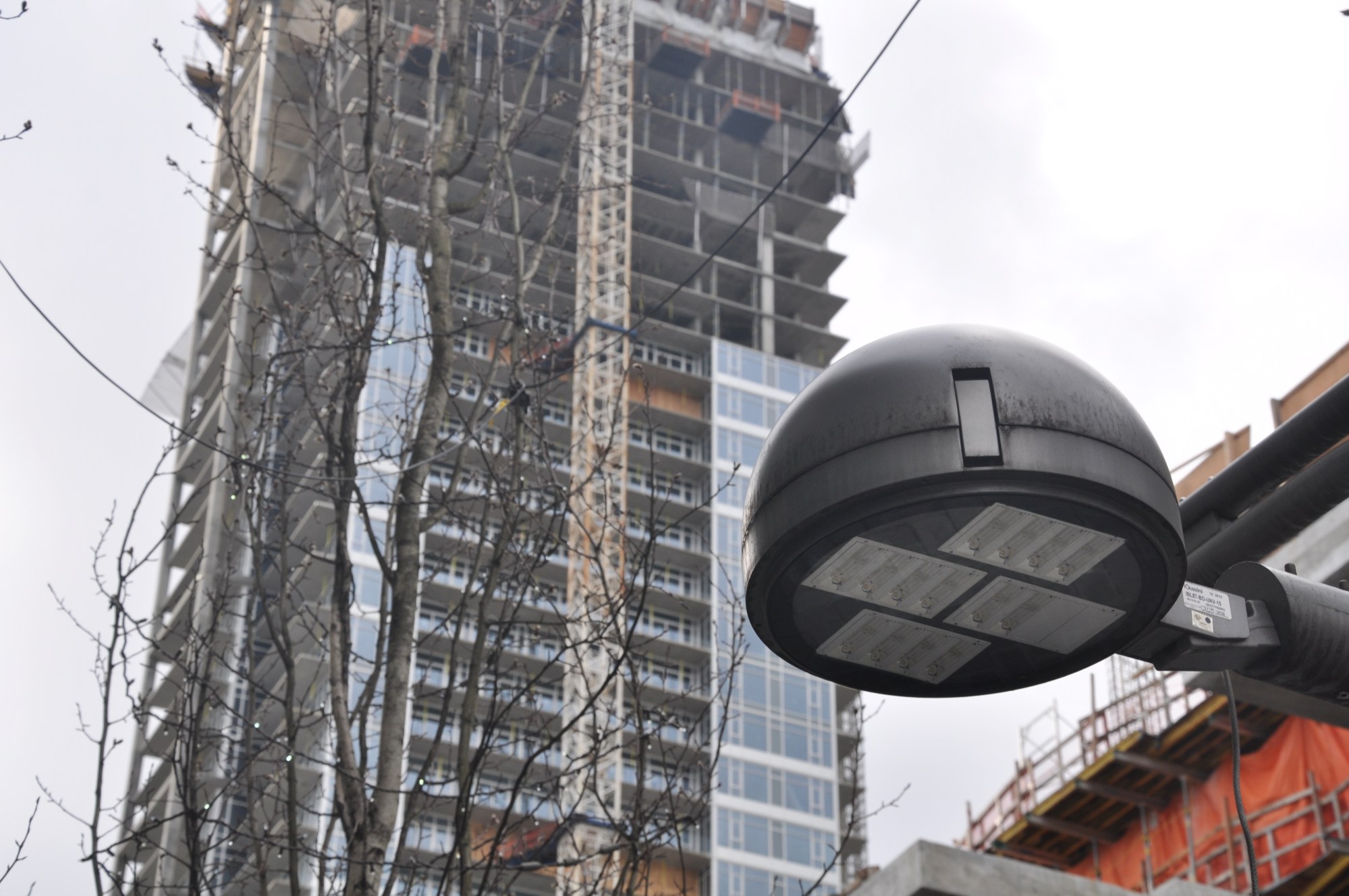
Originally written in Spring 2020 for my introductory planning course
History
Station Square is a part of the Metrotown neighbourhood of Burnaby, with a SkyTrain station to the south, McKay Avenue to the West, and Kingsway to the North. In the early 1900’s, the Silver family farm became a Ford automobile plant, and in the 1980’s it was redeveloped into the original Station Square (Station Square, n.d.).
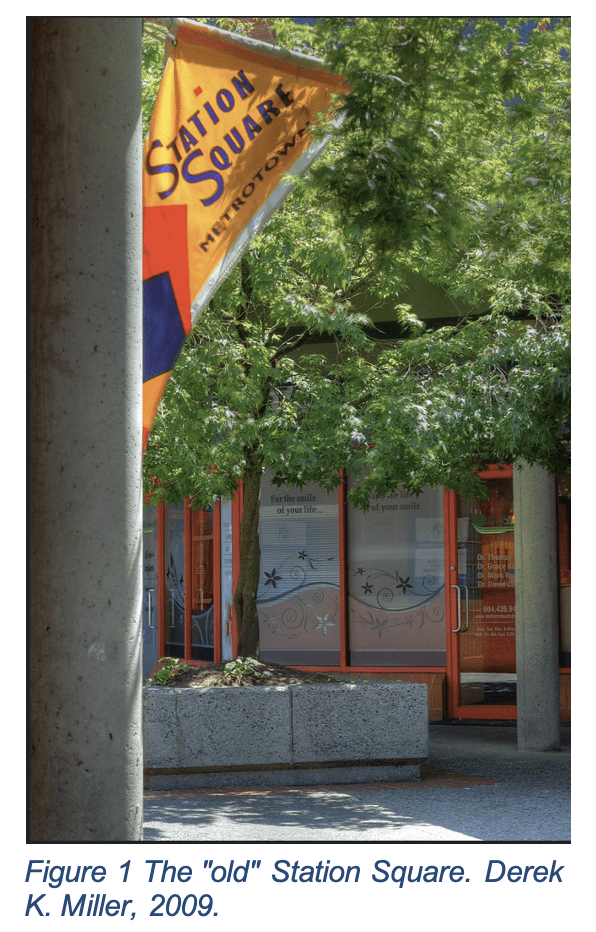
It was originally a shopping and services centre with brick covered walkways and a large parking garage (fig. 1). Infamously before the grand opening, the Save-On-Foods was quickly dubbed “Cave-On Foods”, when the roof collapsed and several cars were destroyed (Naylor, 2019). In 2004 the land was acquired by developers to create today’s Station Square.
It is claimed to be Western Canada’s most successful real estate development, and “Burnaby’s most central urban locale” based on the essence of vibrant European promenades (Anthem Properties, n.d.). Station Square was re-built starting in 2013, and five towers lined with shops, restaurants, transportation, and services will be fully completed in 2021. They frame the area as a “new downtown”, reflected in its dynamic streetscape with a transit hub, library, shopping, Kingsway, and “Restaurants Row” (Station Square, n.d.) [fig. 7]. The identity of Station Square is inherently connected to the surrounding neighbourhood.

Place-making
Cilliers and Timmermans describe places as “spaces with meaning”. They are places we care about and socialize in; places that are lively, secure, and distinct (Cilliers and Timmermans, 2014. p. 414-415). I argue that Station Square contributes to place-making, as it addresses the “key attributes” of a place (fig. 3). However, when you get to the “intangibles”, Station Square is missing things like Indigenous representation, volunteerism, and diversity (in home type).

It is a contained microcosm of a downtown, but it is also connected to the major arteries of the city. Some words that come to mind from my first impression include: compact, busy, bright, connected, and congested. Nuu-chah-nulth academic Charlotte Coté believes that “place roots individuals in the social and cultural soils from which they have sprung together, holding them there in the grip of a shared identity” (Coté, 2017. p. 95). This holistic view is something Station Square can strive for.
Planning as place-making
Resiliency Planner Christine Callihoo told our planning class simply and effectively that everything we do starts with planning. There are a myriad of approaches and philosophies for how to create a safe, vibrant, and inclusive public space. But in the context of places like Metrotown, Cilliers and Timmermans’ participatory planning is a good framework for including marginalized community voices. Developers conducted community consultations for Station Square, but their nature was not described (Station Square, n.d.). Ideal consultation should have many languages, easy-to understand proposals, and a variety of meeting times in an accessible place. One of the biggest cultural successes of Station Square is an Asian grocery store on ground level, which reflects the local demographics. Integration of community suggestions and needs is key to a good public space. Being next to one of the busiest transit hubs in the city, and the second largest shopping centre in the country, Station Square is one of the main corridors for community activity. Station Square overtly addresses four of Peter Calthorpe’s “7 principles for building better cities”: mixed use, walkability, connectedness, and rideable transit (Calthorpe, 2017). I am skeptical whether developers truly care about making this a thriving community, and are just prioritizing profits coming from their expensive condos. Is it really for everyone, or just those who can afford it?
Room for improvement
Living in the neighbourhood my whole life and observing space in detail for this paper, Station Square doesn’t feel like it is at its true potential. Crossing the intersections is dangerous (fig. 6). Silver Drive should be closed to traffic completely, opening it up to more seating, art, and safe walking. There is a stark juxtaposition where an old entrance to Metrotown mall is sandwiched in between the two new portions of Station Square (fig. 5). A 100-year master plan for the entire Metrotown will have new walkable North-South through-streets, mixed use, and walking plazas, truly defining the area as Burnaby’s Downtown (CBC, 2019).
One of the biggest issues in this neighbourhood is the housing crisis. Glittering new towers exemplify gentrification in Burnaby. Just south of the train, swaths of mid to low-income rental housing have been a major aspect of the community for decades, but many “demovictions” have left people displaced (Bernardo and Wong, 2019). Protests show that there is a vocal resistance movement steeped in local politics.

Station Square should have a mix of market price, social, and renting housing units. But most of these towers are filled with million-dollar condos. The Silver Drive promenade itself could use more colour, Indigenous cultural expressions, and no cars. A more aggressive environmental focus would be ideal, prioritizing renewable energy, fair trade and local food, and rainwater capture.
Reflections and Photos
The only negative experience I had walking around was almost being hit by a car a couple of times. The crossings are very exposed and badly controlled. Besides this, the hustle and bustle of a Saturday afternoon felt vibrant. After looking up and really observing this place for the first time, I realized how much construction still defines the block, and I am looking forward to the finished result of Station Square’s place-making efforts.
Select photos I took are below. For the full album of photos, see here.


My family and I grew up and are greatly tied to this neighbourhood, so I wanted to include some supplementary photos from my childhood.

Top Left: Before it was Metropolis at Metrotown, the mall was still called Eaton Centre. I think that’s Crystal Mall being built in the background. (1998)
Top Right: My late father, Derek K. Miller, with my younger sister Meredith at Station Square. (2009)
Bottom Left: Meredith and I at Station Square’s Red Robin restaurant. We had many family meals and birthday dinners there. (2006) – When my mom moved in to the neighbourhood in 1995, the restaurant still had a smoking and non-smoking section.
Bottom Right: Me, the stylish Marina, on Station Square’s fountain. (2009)
References
Anthem Properties. Station Square: Residential. (n.d.). Retrieved February 8, 2020, from https://anthemproperties.com/properties/station-square/
Bernardo, M., & Wong, D. (2019, February 7). Could Burnaby be next, when it comes to taking action to stop ‘renovictions’? Retrieved from https://www.citynews1130.com/2019/02/07/burnaby-renovictions/
BuzzBuzzHome. (n.d.). Station Square-Tower 4 in Burnaby, BC: Prices, Plans, Availability. Retrieved February 8, 2020, from https://www.buzzbuzzhome.com/ca/station-squaretower-4#image-All-1
Calthorpe, P. (2017). Retrieved February 8, 2020, from https://www.ted.com/talks/peter_calthorpe_7_principles_for_building_better_cities/up-next
CBC News. Burnaby approves creating 100-year plan to make Metrotown city’s downtown. (2019, October 29). Retrieved from https://www.cbc.ca/news/canada/british-columbia/metrotown-burnaby-downtown-redevelopment-plan-1.5339075
Cilliers, E. J., & Timmermans, W. (2014). The Importance of Creative Participatory Planning in the Public Place-Making Process. Environment and Planning B: Planning and Design, 41(3), 413–429. doi: 10.1068/b39098
Coté Charlotte. (2017). Spirits of our whaling ancestors: revitalizing Makah and Nuu-chah-nulth traditions. Vancouver, B.C.: Langara College.
Miller, Derek K. Photos from his personal Flickr. Retrieved from https://www.flickr.com/photos/penmachine/collections/
Miller, Marina M. Photos from her personal Flickr. Retrieved from https://www.flickr.com/photos/76437796@N03/albums/72157713029376843
Naylor, C. (2019, October 4). 1988: Miraculously, no one dies in Burnaby’s ‘Cave-On-Foods’ disaster. Retrieved from https://www.burnabynow.com/community/blast-from-the-past/1988-miraculously-no-one-dies-in-burnaby-s-cave-on-foods-disaster-1.23966971
Station Square. About Station Square: Station Square at Metrotown. (n.d.). Retrieved February 8, 2020, from http://stationsquare.ca/history/
Station Square. Metrotown Shopping: Station Square at Metrotown. (n.d.). Retrieved February 8, 2020, from http://stationsquare.ca/shopping/
 marina miller