I have a tendency to bump my knee on sharp furniture, or trip on Vancouver’s mangled sidewalks. My most recent bruised knee represents something bigger than my clumsiness.
As I search for a job, I’m taking advantage of my free time by doing some travelling. It’s a great privilege to be able to do so.
While living in the UK, I took several solo trips and learned there is beauty in that solitude, being able to shape each day completely by your own whims.
My biggest trip this year was to the Maritimes, somewhere I’d been interested to see. I was intrigued by the geologic history, cultural landscape, and urban planning.
Flights were most direct to Halifax in late September, so I decided to start there and drive around Nova Scotia in my first ever rental car. Did I nearly hit a deer within the first day? Sure. Builds character.

Chester, Nova Scotia
Halifax reminds me of London, Victoria, and New Westminster with it’s British architecture and old city stink. I enjoyed music from talented fiddlers, chowder from talented chefs, and a buzz from talented brewers.
While I learned quite a bit of colonial and military history on this trip, I made a point to visit places where I could learn from the region’s Indigenous peoples (Mi’kmaq) and Black and African Nova Scotians.
One such stop was the Africville Museum.
I remember learning about Africville in public school Social Studies. With settlement dating back to the 1830s, Africville was a Black community in Halifax’s North End for over 120 years.
“Despite the prevalent perception of Africville as a ‘slum’ populated by ‘squatters’, residents paid taxes, had meaningful employment, tended their gardens, raised their children and took pride in their homes, however modest. Those who lived there recall a community of brightly painted houses where neighbour helped neighbour.” (Africville Museum)
In the 1960s residents were relocated, many to social housing, and the entire community was demolished. Rather than be redeveloped as once intended by the city, it is now a public park and the site of a museum.
Urban planners played a strong role in these injustices. The urban renewal movement and clearing of so-called ‘slums’ in the midcentury was prevalent across North America.
My urban planning classes at Langara used examples similar to Africville to show how planning tools can be used for discrimination and upholding colonial agendas.
I was excited and intrigued to visit such an important place as Africville, especially as an urbanist.
Beforehand, I spent the morning on Georges Island, a military fort and historic site in the Halifax harbour. Military history isn’t a keen interest of mine, but it was an interesting trip by boat to the grassy drumlin island positioned right next to the modern cruise ship terminal.

Georges Island
After my trip to Georges, I set out for Africville. But very quickly, I experienced a failure of Halifax’s urban planning.
As a tourist who wasn’t scheduled to pick up my rental car until the following day, I had no vehicle to get around.
This wasn’t an issue so far, as I took local buses which connect to Downtown. I could even load money onto a mobile app.
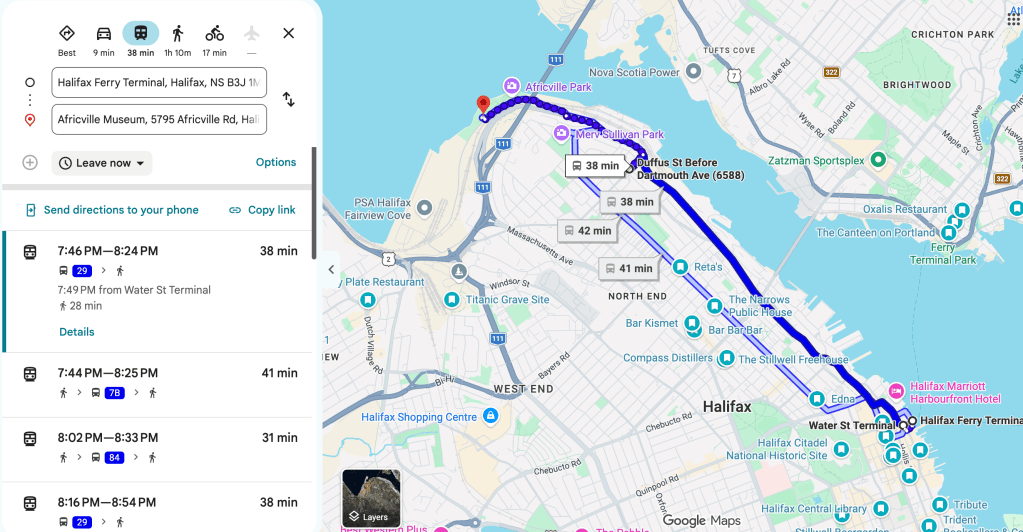
I was trying to save money where I could, and seeing the 40 min transit duration on Google Maps, I decided not to take an Uber to Africville.
The transit route involved one bus and about a 20 minute walk, which seemed suitable for me.
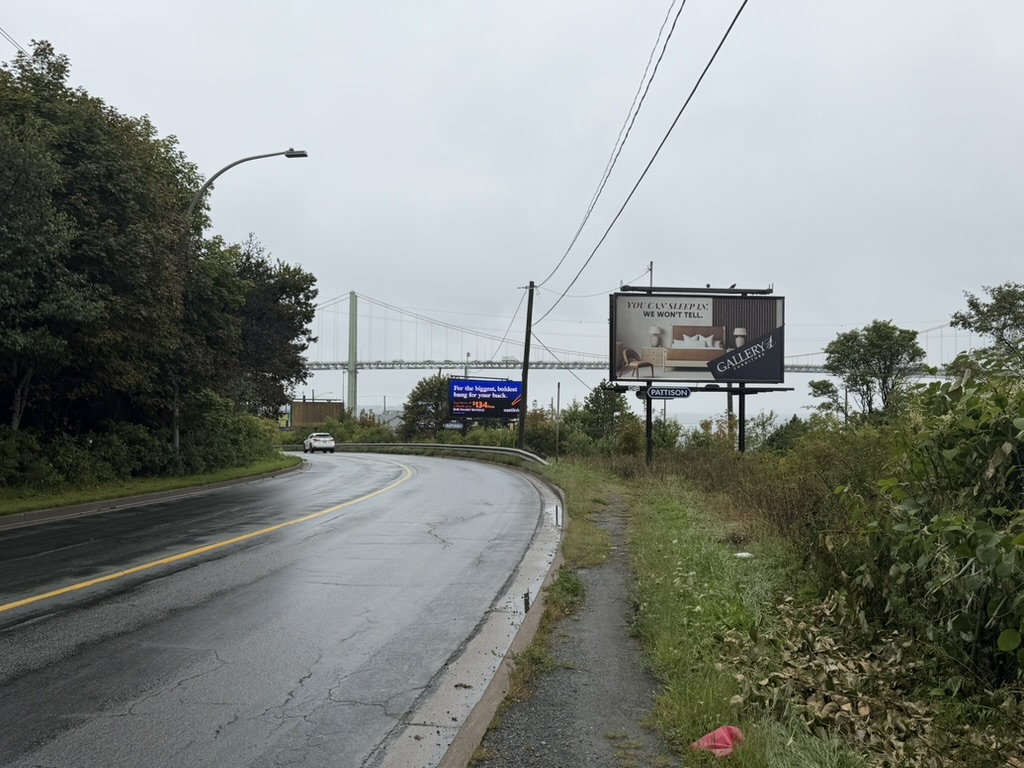
The bus dropped me off next to a strip mall parking lot, and when I turned my map in the direction I needed to walk, I was immediately confused.
There was no sidewalk, and it was a busy truck route.
Double checking I needed to go that way, I even opened StreetView, and that indeed was the only road.
I decided to take the risk and forge ahead, as there was a partial guardrail and a ‘found path’ created by other pedestrians.


It was a loud, wet, shrubby, and slightly scary walk along the road. As I often manage to do, I banged my knee on the guardrail at the end of the road, as I needed to step over it.
The next stretch wasn’t much better; walking over train tracks, past shipyards, and under the mighty MacDonald bridge which connects Halifax and Dartmouth.


Finally reaching a sidewalk, I then cut through Africville Park to make my way to the museum.


The irony of this short but risky journey was immediately clear. In order for any tourist or local to get from the seemingly well-connected Downtown Halifax to one of its most important cultural sites by transit, you must take an unsafe walk.
I am a relatively able-bodied person, and even so I still managed to hurt myself. For many people, that walk would be impossible and dangerous.
Seeing the large yellow sign at the top of Africville road deepened the irony; the city invested in a marker to show vehicles where to go, but did not create an accessible route for transit users and pedestrians.
I’m not the only tourist or local to point this out:
“I’m so embarrassed for our city when tourists discover this.” (r/Halifax)
So before I even entered the door of the small museum building perched on the Bedford Basin, I had learned a lot about how this Black community was, and is, regarded by the settler government.
Was it surprising? No. But it was disappointing as a visitor who had seen lots of acknowledgement for Indigenous and Black Nova Scotians in other parts of the city.
Now a public park and place for learning and gathering, Africville was a vibrant community for over a century until the local government destroyed it.
“The means of displacement served as a metaphor for how the community of Africville was regarded: the city moved some of the the residents’ belongings in municipal dump trucks.” (Africville Museum)
I admit that I assumed that Africville existed a very long time ago, far before my time.
That assumption was quashed the second I walked into the museum, as I joined a tour led by a previous resident of Africville.
Wet and cold, coming into a welcoming museum space felt like a hug. I wanted to come here to learn, and my expectations were far exceeded.

The former resident and I chatted about the lack of accessibility for pedestrians to get there. It is a known issue for museum staff, and it turns out they’ve been advocating for better transit and street infrastructure for a while.
Halifax seems to have started a transportation study in 2021 after a petition was created, but I couldn’t find any significant updates five years later.
Once I got home, I made sure to send Halifax an email with my experience and photos of the route. I have hope that if enough people speak up, especially privileged tourists, that the city may do something.
Africville as it is today isn’t going anywhere. In fact, a museum leader gave us an optimistic talk about their vision for future development on the site, and active community initiatives like a sailing school.


They made an effort to end our visit on a high note, which to me was a reflection of the resilience of the Black community in Halifax, many of whose families have been in town for centuries.
I left the museum with heaviness in my heart, but happiness for the future of this important place. It will hopefully be a place for gathering, learning, and prosperity for centuries to come.
Tired from a long day of sightseeing, I opted for an Uber to get back to my accommodations. It was an hour on transit, or a seven minute drive.
Please consider donating to the Africville Museum, or reading about their story if you are not able to.

