Have you ever been walking down the street and seen a door at the base of a tree? Or a flower pot with figurines in the soil?
In Vancouver’s Mount Pleasant neighbourhood, these “fairy gardens” are plentiful. For me, they create a great sense of joy, adding an innocent and whimsical layer to the urban fabric.
When my classmate proposed this topic for a group assignment, I was immediately on board.
For Social Planning class this spring, we were asked to create a Jane’s Walk, an annual festival of citizen-led walking tours whose namesake comes from legendary urban activist Jane Jacobs.
From concept to reality
Caitlin, Scott, Hanna and I dove in to our topic with enthusiasm. We had so much fun writing the walking tour, we decided to submit it to the festival.
We started by assuming it would be fun to take people around to visit the cute fairy gardens in Mount Pleasant. But as keen urban planners in training, we went deeper.
Through our walk, we aimed to answer questions like:
- Why do humans feel emotional connections to inanimate things?
- How do small, intentional objects on the street transform our sense of place?
- What happens when the mundane becomes enchanted?
After some online research on the history and perspectives on fairy gardens, we got outside. It was fun to walk around searching for little setups, often quite hidden. From a long list, we narrowed it down to eight stops.
Here’s an overview of our Jane’s Walk, “Fairy Gardens: Community-Made Magic”.
Walk stops
Stop 1: Jerry the Snake
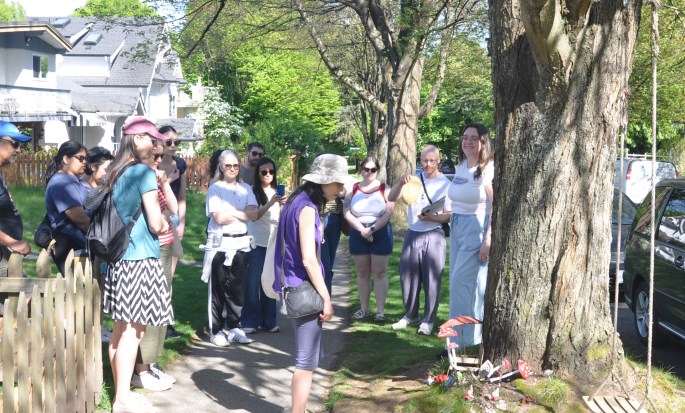
At this infamous installation at Ontario and 16th, we ran into a neighbour who told us about how it started: one triangular rock which the neighbour kids thought looked like a snake’s head. From there, community members have been painting and adding rocks.
If you look a bit higher than Jerry, you will see some strings around a tree. They hold some little cutout red dresses and orange shirts. We used this as a moment to acknowledge the land we were presenting on, and the significance of Truth and Reconciliation.


Stop 2: Baby Angel of Mount Pleasant
If you walk by, you’ll likely miss it. Nestled in a dead tree, this peculiar sculpture comes equipped with rubber baby hands. We used this stop to point out how “fairy gardens” can mean a lot of things. One of our teammates is from the UK, so she discussed some folklore and history behind traditional fairy stories, and asked the audience if they have any similar creatures in their cultures.


Stop 3: Dragon Garden
On the stump of this street tree are a few charming dragon toys. The once orange traffic cone used to mark the stump was even painted blue and adorned with flowers.


Stop 4: DinoLand
This stop further proves the point that there don’t need to be fairies in a fairy garden. The creator came outside his door to tell us about it, which was a treat. We posed the question to the audience: if you could make any theme for a garden, what would it be?
Scenes like this aren’t folklore, but they are equally enchanting. They invite creativity and connection. A child passing by might add their own toy dinosaur, and suddenly the scene becomes a shared creation. It’s proof that small bits of magic can spark even more.

Stop 5: Gnome Cluster
This stop is a great example of neighbour‑made placemaking. There is so much variety here: some gnomes are at ground level, others are perched up in the tree, and others are using the birdbath. It creates a little vertical neighbourhood.


Stop 6: Doors for Days & Stop 7: Fun Fungi
For the two stops I wrote, I wanted to take the opportunity to talk about the psychology of fairy gardens. We had a discussion as a group about how seeing these creations make us feel. We heard “joy”, “whimsy”, and “happy”.
I also mentioned how these can stir up negative emotions. Inevitably, the wind, rain, leaves, moss (and perhaps fairies) will wear the gardens down. Someone may come along, whether they created this particular garden or not, and refresh it or re do it, but they may not.


The scene may become more tightly woven into the urban landscape, becoming less visible and more weathered. It may be forgotten or eventually covered by moss completely, we don’t know.
The lack of central authority managing or cleaning these setups is inherent to their significance, being made by people in their own neighbourhoods for other neighbours.
In the 7th stop’s case, the creator also came outside, and it was awesome to see their own joy.
When we see these creations, whether it sparks positive or negative emotions, we are projecting significance on it simply by acknowledging it in our own minds. I touch on a similar topic in a previous piece which talks about lost street objects and intentional street art.
Stop 8: Mural Wings
While this isn’t a fairy garden, we thought the painted wings were a nice symbol and photo opportunity to wrap up our walk.
Public art painted on the wall like this is another fascinating topic, and there could be several other walking tours just on this sort of thing.
How people express themselves and issues in their community through art, whether sanctioned or not, is a key feature of many cities.
On our first Jane’s Walk, we only scratched the surface on how urban spaces are physically altered by the people living there. In this case, we used the concept of the fairy garden as a fun example of how humans add beauty and innocence to the streets.


Reflections
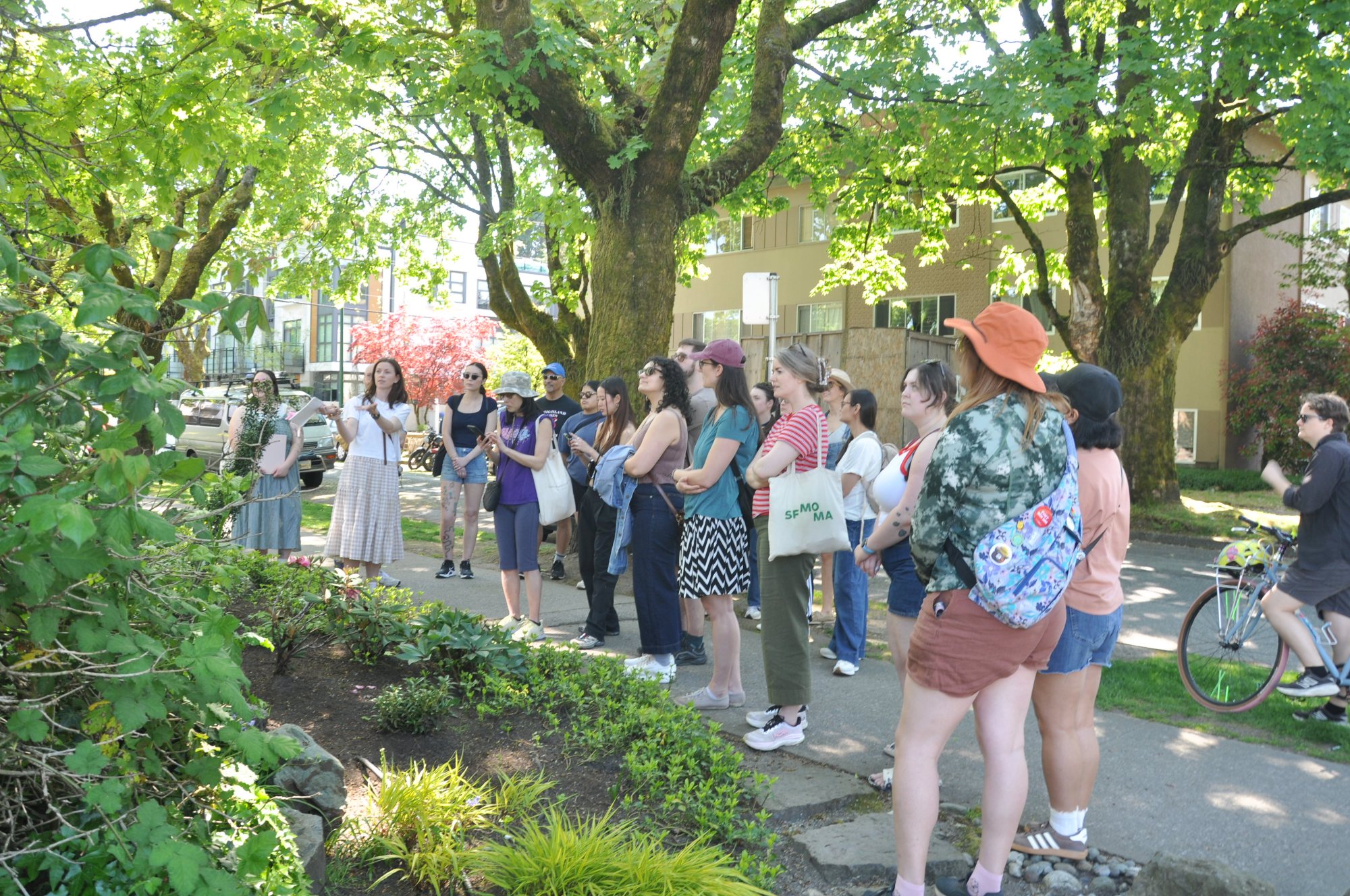
Jane’s Walks are not typical, Leaders are encouraged to create dialogue with the audience rather than just talk at them. We took this on, adding discussion questions to each of our eight stops in Mt. Pleasant. The nature of our topic is particularly suitable for community dialogue, and conversations were lively!
We were granted beautiful, warm weather on walk day, but even more beautiful was what we learned from the community members themselves. On three occasions the actual creators of the fairy gardens came out of their houses to talk to us.

We gained insights into the motivation behind these placemaking creations, and were able to show our appreciation and joy right back. It was exhilarating to see our walk gain this completely organic dimension.
Fairy gardens wouldn’t have the same impact if they were centrally managed, funded, or tracked. In essence, they are community-made and community-enjoyed. It’s one of the simplest tools for placemaking in the city.
Public speaking is something I’ve worked hard on for several years, and this was a whole new method. Leading the walk with my classmates felt fluid, low-stakes, and empassioned.
It felt amazing to share some happiness with people in my community, both strangers and friends. I am so proud of my teammates, who are so well spoken and enthusiastic.
Together, things went smoothly and the audience was super engaged. We couldn’t have asked for much better. I could definitely see myself leading a walk again, whether on fairy gardens or something new.